The felling of timber in the British Isles, whether privately owned, in forest or hedgerow, is subject to control by the Forestry Commission. There is some similar type of control in most countries.
Scouts should fell only when necessary, when the tree is dead or beyond hope of recovery, or is dangerous because of the situation. For every tree felled, six should be planted, not necessarily in the same place. Felling and tree surgery should be done in winter when the sap is down. Planting in late Autumn or in early Spring in open weather (i.e. No Frost).
FELLING
DIRECTION OF FALL - INWARDS
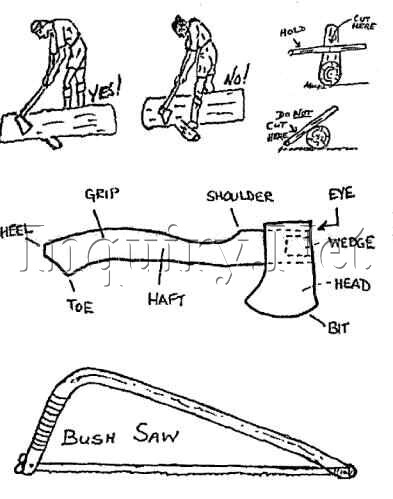
Fell flush with the ground if possible unless landowners request otherwise. Use saw in preference to the axe (Felling axe is suitable for small timber only.)
1st: Decide the direction of the fall, taking into account the surroundings, natural lean, fall of ground, balance of tree (i.e. weight of head), direction and power of the wind.
Fell uphill for preference. Avoid felling across ditches or hollows. Rope the tree where necessary to control the direction of the fall.
2nd: Remove spectators, clear surrounding to allow free swing of the axe. Make ground firm for standing.
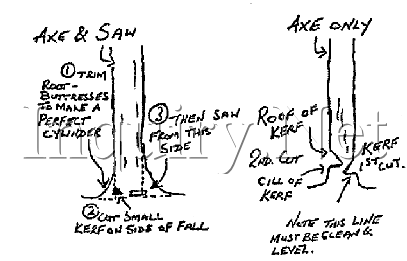
3rd: Trim away 'buttress' roots and coppice growth at the base of the tree to make a perfect cylinder. With the felling axe, cut small clef on the side of the fall. This is the HINGE CUT and care should be taken that the line of the kill and roof is clean and level.
NOTE: When cutting kill with the felling axe, the rule is KEEP BACK HAND AND BACK OF AXE DOWN!

4th: With crosscut saw, start cutting from other side of the tree KEEP THE BACK OF THE SAW DOWN (it will tend to creep up on you!). Use wedges if necessary to prevent the saw jamming.
STOP! - when the tree shows signs of giving. Clear the danger zone.
BEWARE! - of the back kick from the butt of a falling tree.
TRIMMING
1st: Examine to see whether the tree is supported on any branches and liable to move. Remove the supporting branches and bring the tree to a safe rest.
2nd: Work from the butt. Trim small stuff first. Cut with the grain - upwards. Beware of glancing axes; work across the trunk if possible.
3rd: Cut the larger branches, working upwards from the butt.
4th: Stack the brushwood with the butts together. Cut cord wood into convenient lengths. Pile neatly and clear the ground.
LOGGING UP:

With axe: along kerf (see illustration, above), should equal diameter of the trunk (If cutting from both sides, half diameter.
With saw: work steadily and rhythmically. Pull don't push.
STOP WHEN TIRED
TREE SURGERY:
Best done in winter, when the sap is down and the tree is not likely to bleed. Actually a surgical operation, requiring some knowledge of the growth of tree. Remove dead or decaying branches close to the trunk, making the first saw cut on the underside to prevent tearing. Leave no stumpage. Pare smooth and cover. Remove 'coppice growth' from around the base of the tree. Remove creepers, fungus, etc.
See Also:
Axe, Saw, & Knife for Traditional Scouts
Tree Felling for Traditional Scouts
Ernest Seton's:
Axe Use
Rules for Using a Knife & Hatchet
Dan Beard's:
How to Use an Axe
How to Split Logs
Log-Rolling
How Logs are Notched
How to Use a Cross-Cut Saw & Froe
Traditional
Training Handbook
©2003 Baden-Powell Scouts Association
