By Dan Beard
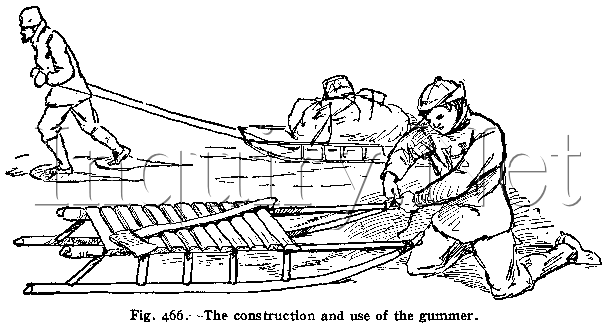
The Gummer is a hand sled built on the general plans of The Jumper, and it is called a gummer because it is somewhat similar to the ones used by the men known as gummers who live in the forests and make their living by collecting spruce gum for children and "sales- ladies" to chew.
The Runners of a Gummer
are lower in proportion to its size than are those of a jumper, but they are made in the same manner as the latter. The reader will of course understand that a gummer is built of very much lighter material than a jumper.
As may be seen by reference to Fig. 466 the runners are bent up until they reach the protruding ends of the top rails, when they are securely bound in place with thongs, or fastened by nails to a cross-piece which is omitted in the illustration. If you are the happy possessor of a piece of board
The Top of the Gummer
may be made of this, but to many minds the presence of a piece of sawed lumber savors too strongly of the effete civilization of towns and cities. In the woods one likes to have which, in this case, is a top made of halved pieces of spruce, pine or other wood, or of shakes, splits or clapboards, as the small, rough boards split by woodmen from quartered logs are variously called, according to the locality in which one happens to be camping. Fig. 467 shows a low sledge built jumper style, but with an elevated seat and

A Tandem Rig
This is used in narrow trails which exist in some sections where roads are wanting and where the winter snows smooth the trails by obliterating the stones and logs which impede summer travel.
The Body of a Jumper
can be finished in any style which one's time and material will allow. A good top for a jumper can be made in the same Manner as the runners; that is, by the use of spokes and a rail, as is shown in Fig. 468. Straw or hay may be used for seats, if there is any such material obtainable, and if not, one can fill the crib with the sweet smelling balsam, upon which we all love to sleep while in the woods. The balsam may not be so warm as hay or straw, but it is soft to sit upon, while its perfume appeals to one's poetic idea of the forest; and blankets and wraps may be de pended upon to keep out the frosts, as one goes bouncing over the "thank you marms" in the improvised sleigh, proud to be a real exemplification of
The Simple Life
It will be noticed that the jumper in Fig. 468 has the top rail I of the runner prolonged into shafts and the lower rails of the runners curved up and made fast to the shafts. This can some times be done when the sleigh is so light that the stiffness of the runners, if prolonged into shafts, would cause the jumper to rear up on its hind legs, so to speak. Yet the wood may be elastic enough to be forced up to the upper rail of the runner and made fast there, as it is in Fig. 468.

When you have horses, you, in all probability, also have wagons, and in that case it may be possible to take the shafts from a wagon and attach them to a jumper, or it may save time and labor to remove the whiffletree from one of the wheeled conveyances and attach it to the sleigh, to which to fasten the traces.
But if there are no wagons handy there will probably be no traces, and in that case ropes must supply the place of traces and reins. With ropes for traces a rude
Whiffletree
may be made of a stick notched at the end to receive the rope and notched in the middle, where it is bound to the cross brace between the shafts, as shown by Figs. 469 and 472. In the illustrations good harness is depicted upon the horses, but that is because they are picture-horses, and good harness is always as acceptable to the illustrator as is bad, or improvised, and looks much better than either; but in the woods, with only pack horses at one's command, improvised harness of ropes or thongs Will probably be the only kind available, and a breast strap must then be substituted for the collars worn by the animals in the diagrams.
Home Made Sleigh Bells
are not a difficult proposition to one who wishes them for use and not appearances, and tobacco, meat, or tomato cans, which are to be found around almost any camp, will be as much admired by the deer, moose, wolves, coons or jack rabbits as the most expensive Russian sleigh bells. If a few round pebbles be placed inside of the cans they will make as much noise as necessary to apprise any other wayfarer of the approach of the jumper. Fig. 470 shows how the cans may be hung by strings run through nail holes, and Fig. 468 shows some such crude bells attached to the shafts of the jumper.
It is possible that one may want to build a heavy sledge on the jumper plan, for the "toting" of weighty dunnage or heavy material of some sort, and in that case the ordinary jumper runners, if made tall, even when built of heavy material, may be liable to spread, or fold up under the sleigh. Fig. 471 shows a cross- section of a jumper with braces to prevent such accidents, simple affairs nailed in place so as to stiffen the frame. As emergencies arise change the shape to suit the conditions, while keeping the real essentials.
